istanbul, izmir, antalya, ankara escort bayan linkleri
istanbul escortAntalya Escortizmir escort ankara escort


Join the Flock! Litfuse Publicity Group blogger


Enter your email address:

Delivered by FeedBurner


May 7, 2010


In honor of Mother’s Day, I want to highlight one of my all-time favorite writers, Marion Bond West. She’s the author of hundreds of stories in Guideposts magazine, as well as several books. I grew up devouring my mother’s Guideposts as soon as they came in the mail, and when I was in college, my dear grandfather started giving me gift subscriptions, which continued into my 30s. It’s because of Guideposts that I learned to love the art of writing inspirational essays.

Marion Bond West’s stories always leaped off the page at me, especially because we’re from the same state of Georgia. I couldn’t believe how effortless she made it seem to write about her deep, dark secrets and struggles. It’s this type of transparent writing that opens a reader’s heart. Marion opened mine when I could tell her stories were probably written with a box of tissues close by.

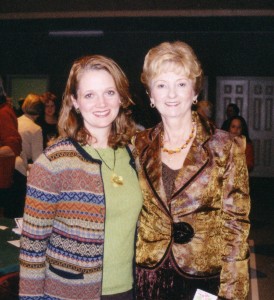
I had the awesome privilege of sharing dinner with Marion and her husband when she was the keynote speaker at a Christmas event in my hometown a few years ago. I wrote up this experience, and it’s still one of the most-read posts in my archives, which you can read here.

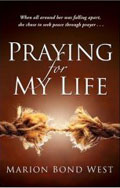
When her book, Praying for My Life, was released, I wanted to review it for my Christian Women Online Book Buzz column, and I asked her publicist if I could interview Marion. Which I did, by telephone.


She was so gracious to take the time to speak to me, even though she has millions of readers who would love a minute of her time! I asked her the question that had been burning on my heart after reading her book, “How do you KNOW God is speaking to you?”

And she answered, “Oh, He’s speaking to you all the time. Just listen, and you’ll know.”

I want to be a better writer. I want to be able to write more transparently, like Marion. But I have such a hard time doing this, and I especially don’t feel comfortable writing about my kids. You’d think with a blog called “Mom 2 Mom Connection,” I’d get a kick out of blabbing about my own children, but I don’t. They’re the source of my private joys and frustrations, which I write about mostly in my pen-and-paper journal. It’s a safe, quiet place for me to work out my faith.

As I grow older, and as my kids grow older, perhaps I’ll feel more comfortable opening up. It’s easier to share a lesson learned when the lesson is over than when you’re in the midst of trial. Right now, I’m still focusing on survival.

I think that’s why I’ve enjoyed Marion’s stories so much about her early years of mothering. It was hard, sticky, messy, exhausting, but when she wrote about it, she’d lived through it and had gained the perspective she needed to encourage the rest of us. Her story, “Glory at the Garbage Can” is my absolute favorite. In it, she writes about the time when her twin sons were two, and she fled the house into the night, carrying sacks of trash. Alone at the garbage can, she finally has a moment of privacy, and as she confesses her failings as a mother, God intervenes, and gives her joy. I love this kind of writing. I just don’t know how to do it!

I recently discovered that Marion Bond West and her daughter, Julie West Garmon, who is also a wonderful writer, have a new blog together, called Woman to Woman. I can’t wait to browse through their posts! I also discovered a couple of beautiful essays Marion wrote for a blogging friend, Aging Gracefully — From a Seventy-Something Perspective, part one and part two.

Guideposts is currently collecting stories focusing on motherhood. Do you have a memory of you and your mom that you want to preserve? Read here for some examples, and read here to learn how you can submit your own.

I wish you all a Happy Mother’s Day!


May 4, 2010


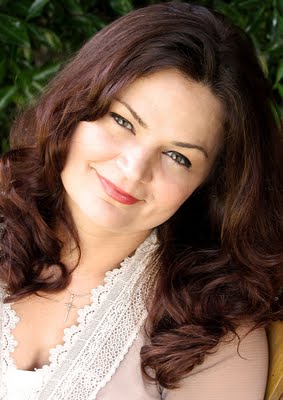
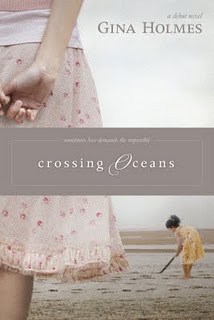
I’m happy today to share with you some exciting news! Gina Holmes, one of my long-time blogging buddies, is releasing her first book this month! It’s called Crossing Oceans, published by Tyndale House. Gina has become a well known writer in the Christian book publishing world through her influential literary blog, Novel Journey. I enjoyed sharing a meal with Gina back in 2007 at the Christy Awards, held in Atlanta. She has definitely been an inspiration to me!

Welcome, Gina! Your blog, Novel Journey, grew out of your own journey to become a published author. Can you tell us a little about your journey to publication?

I’ve been writing toward the goal of publication for something like ten years. I had written four manuscripts that haven’t been published before this one, Crossing Oceans, was contracted. I’ve had lots of rejections and near misses along the way, but I’m so grateful for all of it. Crossing Oceans is my best piece of writing to date and a story I’m so very proud to debut with.

And thanks for mentioning Novel Journey. It has been a labor of love, not just for me, but for the whole Novel Journey team. It’s a great place for readers to discover new authors and for writers to connect and learn. And unlike most things in life, it’s a completely free resource.

As you reviewed novels and talked to a lot of novelists who have had varying degrees of commercial success, was there ever a “dark night of the soul” where you decided this just wasn’t what you thought it was going to be, just wasn’t worth pursuing?

Not worth pursuing? No way! There are so many worthy stories to tell, and it’s my burning desire to do that. Not to say that I didn’t have fleeting moments of despair along the way, particularly when I came close to getting a contract, only to see it fall through at the last minute. But those moments really were fleeting, and I knew God’s timing would be perfect … and it was.

You’ve written several as-yet-unpublished novels, all of them in a completely different genre—thriller/suspense. Crossing Oceans is quite a departure. Do you prefer or find your voice more easily in one or the other?

I grew up reading suspense, so naturally that’s what I thought I should write. I did okay with it and got some recognition in a contest and came close to getting contracted, but ultimately none of those suspense novels ever sold. Then I started reading some really amazing novels outside the suspense genre, and it was like another world opened up to me. It was no longer a thriller I longed to write, but a story that would change lives the way the books I read had changed mine.

When I started Crossing Oceans, I presented it along with a suspense novel I was working on to my agent, Chip MacGregor. I asked which one he thought suited me better. He told me both were good, but that Crossing Oceans seemed more like my true voice, or something to that effect.

It turned out to be a turning point and absolutely the right advice. I’m now writing what comes naturally and absolutely loving it. Chip’s a genius.

How did the idea for Crossing Oceans come to you?

I’m not exactly sure where the idea came from, but when I write, I’m usually working out something in my personal life, past or present. Often it’s not until the story is done that I figure out exactly what.

I think with Crossing Oceans it probably was my relationship with my parents. They divorced when I was a baby. For the first years of my life, I was with my mother, and then when I was in second grade, I went to live with my father. I know what it’s like to be torn, like Isabella, between two families who don’t always like each other but who all love the child they share. Then again, maybe I wasn’t working out anything! Maybe I just fell asleep watching something about a dying mother, and woke up thinking I had a brilliant idea.


Do you ever find your Christian worldview a challenge to convey in your writing or as you communicate with other novelists in the industry?

It’s not difficult to convey in my writing, I don’t think. At least not today. Hey, I’m a sinner. I wish I weren’t and I try not to be, but I always seem to fall short. It’s the same for my characters.

The thing with me, and them, is we get back up, dust ourselves off, and try to do better next time. My faith, in all its imperfection, isn’t lip service. It’s who I am. What I believe. That comes out in my conversations, my choice of clothing, music, friends, and in my writing. It’s very natural for me.

As far as other novelists go, I guess it’s not a challenge. I’m a Christian and not everyone’s going to agree with what I do, or what I write, or what I believe, and that doesn’t matter. My mother said when I turned forty that I would stop caring so much what people thought and really start being who I am. I’m almost there and, as usual, she was right. I would say that in my personal life, everyone who truly knows me is well aware that I’m a Christian. I don’t hide it in my professional life either.

Thank you so much for visiting us here, Gina! We wish you the best with your debut novel and look forward to seeing what’s next in your career!

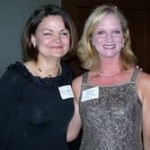
You can learn more about Gina Holmes at her personal website and also see all the fun things she’s up to at Novel Journey. Here’s a picture of me and Gina hanging out together at the Christy Awards in 2007.


Blogging buddies meet!


By: Heather Ivester in: Books,Faith,Writing | Permalink | Comments & Trackbacks (0)


May 1, 2010

I’ve been collecting some inspiring bits of writing-related wisdom for a while and wanted to post them here for you. I hope these links will encourage you in some way with your writing.

Elizabeth Bird, The Top 100 Children’s Novel Poll
If you love children’s books, this is a great list, with a link to detailed comments about each book. You’ll see many of your classic childhood favorites, plus some of the newer ones. Can you guess what the number one book is?

Publisher’s Weekly, Children’s Bestsellers 2009: The Reign Continues
Here’s a great list of the top-selling children’s books from last year. (Yep, Wimpy Kid, Percy Jackson, and Twilight made the top ten. These books are all really different, though. What made them bestsellers?)

Lanier Ivester, Facedown
This essay by my talented sister-in-law appeared on “The Rabbit Room” website and offers inspiration to Christian artists of every type, on why our creative endeavors bring glory to the God of the Universe. Inspiring!

Jane Friedman, Stop Being Afraid of Posting Your Work Online
Publisher & editorial director of Writer’s Digest offers reasons why writers today should post their work online “in a very smart, strategic, and targeted way.”

Jane Friedman, 5 Things that Make Me Stop Reading Websites and Blogs
Another great article, where Jane explains her pet peeves when she’s reading online. She has some good tips for writers hoping to improve the visibility of their website or blog.

Chuck Sambuchino, Be (Slightly) Afraid of Posting Your Work Online.
Why this agent believes writers should be wary about posting their high-concept ideas and fiction online. The rules are different for non-fiction, where the focus is on building platform.

Sarah Mlynowski, The Future is on the Line
What would you say to yourself if you had a magic cell phone that could call you up at age 14? Here are a bunch of YA novelists who wrote what they’d say.

Chip MacGregor, The Best Advice
CBA agent offers ten pieces of writing advice, full of Chip’s typical wit and wisdom.

Brenna Ehrlich, From Blog to Book Deal: How 6 Authors Did It
Here are some interesting stories about writers who turned their great ideas into book form by first creating an awesome blog. Hint: most of them offer people something to laugh about!

And one last quote:
I saw this today on a chiropractor’s sign:
“7 days with no exercise makes one weak.”

Happy reading (and exercising!)

By: Heather Ivester in: Writing | Permalink | Comments & Trackbacks (0)


April 28, 2010

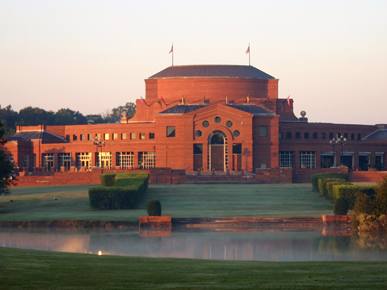
One of my favorite places in the world is a red brick building on an emerald patch of heaven in Montgomery, Alabama.

I’d let the years slip by without visiting. Two decades. Like an old friend, I missed this little oasis of literature and decided to do something about it last fall.

I was supposed to be working on a Nanowrimo project, but things got rough. I took a breather and clicked over to the Alabama Shakespeare Festival website — when inspiration hit!

A play! Yes! The play’s the thing!

I discovered two upcoming Shakespeare plays, All’s Well That Ends Well and Hamlet. I chose “Hamlet” because there are so many famous quotes taken from this play — plus, I figured my son might like the sword-fighting scenes. My husband liked the idea and so we bought a few extra tickets for extended family to join us, (which made great Christmas presents!).

Then the waiting began. April seemed forever away — but finally the big date arrived. We headed down the highway to Montgomery … and a trip down memory lane for me.

When I was an English major at Auburn University, my professors took us to the Alabama Shakespeare Festival every quarter. I remember seeing tragedies “Romeo and Juliet” and “Julius Caesar,” and the comic “As You Like It.” It was such a treat to get away from dorm life and essay exams. I loved seeing the plays performed live on the stage.

I never imagined 20 years later, I’d be bringing my own family with me.

When we entered the theater, the room seemed hazy, as a smoke machine of some sort created an atmosphere of fog. Nearly every seat was filled, and I noticed rows and rows of teenagers.

We sat next to a group of kids, and I wondered if they were on a field trip. I struck up a conversation with their teacher who told me there were 60 students altogether, from a Christian school literary club in northeast Alabama.

The girl next to me wore blue jeans and smiled at me, popping gum and showing her braces. “I can’t wait for this to start,” she confided. “Our teacher told us all about it. I think Hamlet is going to be so cool.”

Behind us, a row of teens chatted and laughed, some texting on neon cell phones, others nodding in rhythm to unknown tunes from their ipods. I wondered if they would get Shakespeare. Would it seem too, you know, ancient for them?

The play began, and we were all spellbound.


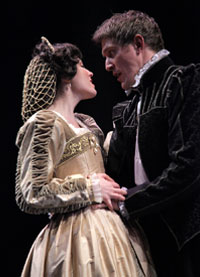
Nathan Hosner’s portrayal of Hamlet was so realistic I don’t think you had to understand a single word to know what emotions he expressed. We held our breath as he soliloquized and felt our eyes water up at the tragedy.

We were the audience Shakespeare originally wrote for, the masses who sought escape from the sweat and toil of Elizabethan England.

I peeked at the girl next to me and the row of teens behind me. They were all leaning forward, perched on the edge of their seats, not a whisper among them. Over four hundred years after this play was written, we were still totally enthralled.

At the intermission, I overheard a girl behind me say, “When are they all gonna start getting killed? I thought everybody dies in this play.”

“It’s coming up,” somebody answered.

And of course, in the end, the tragedy unfolds with devastating consequences. We left, pondering how it all happened, what Hamlet should have done differently, why revenge isn’t the best course of action, etc.

In the program, Dr. William Engel explained:

Part of why this play remains so popular is its fearless examination of human nature. It explores, among other things, authentic responses to grief and mourning, the uncertain line between sanity and madness, the stresses of dating and marriage, and the pressures of living up to parents’ expectations.

Shakespeare spoke to all of us that evening, whether we dressed up in coat and tie or donned our favorite blue jeans. I can’t wait to go back again.

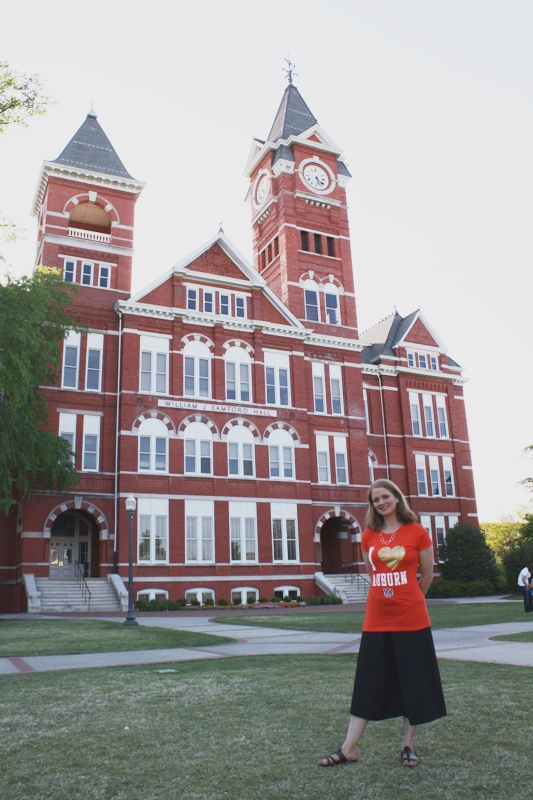
As an added bonus to our trip, we swung by Auburn on the way home, my first time back in 15 years. It’s the place where I learned to love the lines of Shakespeare, and where a whole new generation is reading him now.


Samford Hall, Auburn University


April 26, 2010

It happened over near the lightbulb aisle. In Wal-Mart, where I spend way too much time. I was looking for sheetrock anchors to hang a picture frame on the wall of my new writing space. A few aisles over from where I needed to be.

“Excuse me,” a woman said to me. I glanced up from my list. Was she talking to me?

“Yes?” I looked up at her. She was white-haired, in her 70s perhaps, dressed in comfortable shopping wear.

“Can you reach something for me?” she asked, pointing to an aisle.

“Sure,” I answered, following her. I wasn’t sure if she’d said “read something for me” or “reach something for me,” but I figured I could help her with either task.

When I got to the aisle, I saw another woman with her, about the same age, with a cast on her arm. She looked a little forlorn, and both women began pointing to the top shelf.

“We’d like a couple of those pots up there. It’s just too high for us,” she explained. We were in the garden section, and she pointed to a row of turquoise ceramic planters.

I’m not that tall, but tall enough to reach the shelf. I pulled down a pot.

“We need two,” she told me.

“OK.” I handed her another one. “Is this all?”

She smiled. “That’s all we need. Thank you so much.” She gave one to her friend with the cast on her arm.

As I turned to walk away, I saw both women smiling, holding their matching spring pots, most likely imagining the flowers they’d soon put in them.

And then I felt God’s voice in my spirit, a voice I haven’t heard in a while. He said to me, “You reached something they couldn’t reach. You gave them something they needed.”

I remembered reading a quote earlier in the day, from a speech written by author Max Lucado on writing. He reminded writers that our words are important. Our words can reach places we can’t go, to countries far away, or to the deep crevices of people’s hearts, where they need something.

Lucado says:

Readers invite the author to a private moment. They clear the calendar, find the corner, flip on the lamp, turn off the television, pour the tea, pull on the wrap, silence the dog, shoo the kids. They set the table, pull out the chair and invite you, “Come, talk to me for a moment.”

I’ve had a lot of doubts in the past couple of years about my calling to write. Some days I don’t even have a chance to turn on the computer because I’ve put my calling as a mom in front of my personal dreams. But a few months ago, at my husband’s insistence, I signed up for another correspondence writing course, and God has given me a wonderful mentor, a woman who has successfully published several children’s novels, including one that was made into a Disney movie. So she knows her genre.

She said I’ve had a “crisis of confidence,” and I need to get back in there and keep at it. But I torment myself. Every time I read the words of a great writer, I think, “I can’t do that. I can’t write like her, or him.”

I reread To Kill a Mockingbird last month, and I thought, “Why should I even bother to try? Harper Lee has already written the master work.” And then there’s Madeleine L’Engle who gave us her strokes of genius, along with Catherine Marshall, Katherine Paterson, Lois Lowrey, Linda Sue Park, and all the others I admire.

But I know I heard it. That still small voice. “Can you reach something for Me?”

When those ladies needed help reaching the pots, I was there to help them. I’m not the tallest person around, or the strongest, or even one who’s an expert on gardening. But I was close by. I was the one who could give them the simple help they needed.

Harper Lee wrote one book, To Kill a Mockingbird, and it still sells millions of copies because it’s amazing and everybody loves it. But my nine-year-old doesn’t want to read it right now. She’s reading Prince Caspian, working her way through Narnia. Before that, she finished up Lisa Yee’s hilarious Millicent Min: Girl Genius.

A friend of mine says her daughter, unfortunately, “judges a book by its cover. She only wants to read books that look new and fresh and have cool covers.”

Back to my calling, that still small voice. Is there something I could write that might reach the heart of a child today? A story that connects with one place in one reader’s heart? Perhaps even a story that’s new and fresh and packaged in a cool cover?

Max Lucado says:

Accept it. We need your writing. This generation needs the best books you can write and the clearest thinking you can render. Pick up the pens left by Paul, John, and Luke. They show us how to write.

OK. So I’ll try to push through this “crisis of confidence.” I’ll try to hang in there when my computer is giving me problems and I don’t know how to get it fixed. I’ll get back to blogging, even though I don’t know if I’m really connecting with anyone out there. I’ll just do it anyway, when God puts something on my heart that won’t go away.

As I plow through writing my first novel, I know I face a hard road ahead. There will be rejections and disappointments, and maybe miles of nothing. Maybe my words will never amount to anything marketable.

But I see this sort of the same way I saw dating, back in my early 20s. I went through some heartache trying to find “the one,” but I never gave up completely. Sure, I went through periods of time where I took a break from playing the dating game and accepted my calling as a single. But deep in my heart, I knew, just knew that I wanted to be somebody’s wife and even further down the road, somebody’s mom. Those longings never went away, despite years of waiting and a myriad of frustrations.

So I go back to that deep secret place in my heart where I’ve known all my life I want to write children’s books. I go back to the dinner conversation about five or six years ago, at a Christmas party, when a friend I rarely see asked if I was still planning to write a children’s book.

Who, me?

I go back to my college journals, where I asked God, “Where do you want to send me? What do you want me to do with my life? Will I ever become a writer?”

And now I ask him those same questions, at a different season. I’ve been married to “the one” for almost sixteen years. My children are all here now. The house is quiet for a while, when they’re in school. I have a place to write. My computer works most of the time. I have a mentor who’s pushing me, encouraging me.

I have a draft of a novel I’ve been working on since 2004.

Can you reach something for me? she asked.

I told her yes.

And I did.

By: Heather Ivester in: Writing | Permalink | Comments & Trackbacks (4)


April 23, 2010


I took my daughter to see “The Last Song” a few days ago, mainly because I wanted to see it. I had been asking her for days, “Has anybody at school talked about seeing the new Miley Cyrus movie?” but she said all they’re talking about is Letters to God, which was produced by the same people who gave us “Facing the Giants” and “Fireproof.” OK, so that one’s next on my list.

But I had to see Miley in The Last Song — for two reasons. First, it was filmed in my home state, Georgia! On top of that, in one of my favorite places, on the beaches of beautiful Tybee Island. From what I’ve read, Georgia fought long and hard against North Carolina to be the setting for this movie — so I can’t help but give a little rebel yell at our victory (though you can see here that I love North Carolina too!).

The second reason I wanted to see “The Last Song” is because I’m intrigued by the whole Nicholas Sparks’ aspect. Here’s a best-selling author who wrote a screenplay first with a specific actress in mind, then turned the script into a novel. This seems backwards to the way most films work, so I found that interesting. It reminds me of the rumor I heard that John Grisham wrote “The Pelican Brief” with actress Julia Roberts in mind. You can read more of the story here and on Nicholas Sparks’ website.

I can honestly say we weren’t disappointed. Although critics have poked fun at Miley’s acting, I thought she was wonderful. Give her a break — she’s only 17! She made me laugh — the first half of the movie has some hilarious scenes, especially when Miley/Ronnie meets her beach beau’s parents for the first time.

I think Nicholas Sparks must have had fun writing this scene. Miley and co-star Liam Hemsworth have been slinging mud at each other trying to get his truck out of the marsh. They’re filthy and run back to his house to hose off. Except … his house is a GIGANTIC southern plantation, recognizable to those of us from Georgia; it was filmed at Wormsloe Historic site, in Savannah.

Miley stares up at the live oaks, dripping in Spanish moss, as they pull into his “driveway.” She’s shocked. After all, this guy has been bugging her the whole movie, until he finally convinces her to go out with him.

When she gets out of the truck, her mouth drops open and she says something like, “I didn’t know you were so rich!” This line surprised me and struck me as absolutely hilarious because one of my kids said that recently to a classmate, when we visited her large home for a swim party. The movie is full of good lines like this that make it fun to watch.

And there are baby loggerhead sea turtles, oh so cute! Miley is trying to protect a nest of turtle eggs from an evil lurking raccoon, and she gets a little help from Liam, who just happens to be a volunteer with the nearby aquarium. (aw, sweet. Yes, you girls will think that when you see him in his uniform.) We happen to be big Georgia sea turtle fans and look forward to visiting the Georgia Sea Turtle Center on Jekyll Island every year.

The title of the movie comes from a classical piano piece Miley’s father is composing for her. (Don’t think about this too much, or it will spoil the plot.) When the film begins, Miley is an angry teenager, coming down from New York to spend the summer with her dad, who left the family. She’s a former child piano prodigy — we see newspaper clippings of her playing as a youngster. Moreover, she’s been accepted to Juilliard, if she chooses to go. But in the beginning of the movie, she’s too rebellious and mad at the world. She won’t even go anywhere near the piano.

As the film continues, Miley/Ronnie begins to connect again with the piano as an instrument of healing. Since I’m the mom of two daughters taking piano lessons, I enjoyed this aspect. My daughter and I both found Miley’s piano performances to be inspiring. In fact, after watching the movie, my daughter came home and right away sat down at the piano to practice. The music is really beautiful in this movie.

In the opening credits, I knew I was in for a treat, when I saw that Miley’s mother, Tish Cyrus, was the executive producer. Wow. How many actresses star in a film produced by their mom? Go Tish! In this article, I read that the plot of the film is similar in many ways to the life of Tish Cyrus, so Miley’s acting allowed her to experience many of the same painful emotions her mom had been through.

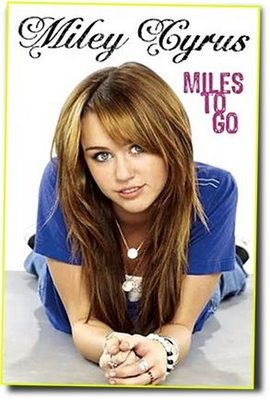
If you go anywhere near a Wal-mart, which I must do frequently to keep our supplies of stuff replenished, you will be familiar with Miley’s autobiography, Miles to Go.


Read it. I enjoyed it. It’s well-written and full of hope. She has a great voice. I don’t know if she had help writing the book (the title page says “with Hilary Liftin”), but it takes you into the mind of a teenager, one who is trying desperately to find her place in the world and not lose track of her rural Tennessee roots. In fact, she asked Nicholas Sparks to name his novel’s main character Ronnie after her grandfather (whom she calls “Pappy” in her book).

Miley Cyrus is not too much older than my daughters, and I guess I don’t want her to grow up. I want her to still act in films that I can take my children to see. We all enjoyed the “Hannah Montana” movie, though “The Last Song” is not appropriate for kids under 9, I feel, because there are some romantic scenes, and the plot is too heavy for the hearts of little ones.

Although she doesn’t sing any during the movie (except for a brief sing-a-long in the car where Liam’s awful crowing drowns her out), Miley Cyrus’ song, “When I Look at You” does play a part at the end. As I listened to it, watching the credits, I had to wipe away my tears, like the other moms around me.

We walked out of the dark theater and back into the Georgia sun, which was just beginning to set. Without a word, I searched around until I found our Miley CD, tuned to that song, and drove off with a sigh. I wish we could have driven straight to Tybee Island, but I had to head home to cook supper and oversee the bedtime routines of five kids.

You can hear her sing it here, with these opening lyrics, which tie in perfectly to the plot of the movie.

Everybody needs inspiration
Everybody needs a song
A beautiful melody
When the nights are long

’cause there is no guarantee
That this life is easy

Yea when my world is falling apart
When there’s no light
To break up the dark
That’s when I
I look at you

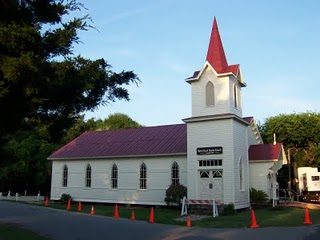
After seeing the movie, I’m already plotting a trip to Tybee. I must see the church which was built on-site for the movie. Any of my Georgia friends up for a summer road trip?


By: Heather Ivester in: Movies,Travel | Permalink | Comments & Trackbacks (0)


April 20, 2010


It’s spring here in Georgia, and our gorgeous dogwoods and azaleas are sending me out into the yard with my clippers, snipping a frenzy of bouquets to spruce up our home. I’m not at all a gardener, but our house rests on property where generations before me still share their love of natural beauty.

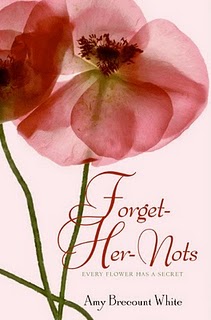
If you’re like me and love flowers, then I must tell you about a new young adult book I recently read by Amy Brecount White. It’s called Forget-Her-Nots and shares the story of 14-year-old Laurel’s blossoming realization that she has a supernatural gift of being able to communicate through flowers.

As I read this book, I felt the author to be one of those few kindred spirits I have in this world. She has a fantastic love of literature and her depth of knowledge blew me away. After reading the book, I wanted to know more about her, and I was thrilled when she agreed to answer a few of my questions.

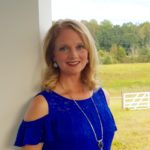
I hope you enjoy meeting Amy Brecount White and will visit her website to learn more about what she’s up to.

Welcome, Amy! How did you get the idea to write a book about the Victorian language of flowers?

It was a combination of factors. I was freelancing a lot of non-fiction articles and always on the lookout for new story ideas. I came across a beautiful coffee table book on tussie-mussies, which are symbolic Victorian bouquets. Although I tried to sell an article on this topic, I never did.

Later, I went to hear author Toni Morrison speak, and she advised aspiring writers to “write the story that only you can write.” That struck a chord with me, and I started to think about my loves and what I cared about most. Flowers, teenage girls (since I’d taught at an all-girls school), literature, and relationships.

I hope you can see all my loves in Forget-Her-Nots.

Oh, yes definitely! That was great advice from Toni Morrison, and I think it’s what makes your book so unique. Are you anything like your main character, Laurel?

Yes, although I don’t have the gift of flowers, I do have a very sensitive nose and adore flowers and gardening. I think all characters have something of their author in them too, even the mean ones. I also coach my daughter’s soccer team and used to play myself.

I’m not surprised to hear that you’re an experienced soccer player and coach! I really enjoyed jumping right into the game with Laurel since I’ve been a soccer mom for several years (though never a player!) Amy, Can you tell us more about how you became so interested in tussie-mussies, which play such an integral role in the plot of your novel?

It came from the book I mentioned earlier and a lot of research into the language of flowers and Shakespeare’s use of flowers. There isn’t a definitive language, but the list in the back of my book contains the most common meanings associated with flowers throughout Western culture. I would love to explore flower mythology and meanings from Eastern cultures — especially India, China, and Japan — in a future novel.

Do you ever send anyone these little bouquets of flowers?

Yes. Before the idea of Forget-Her-Nots was born, a friend and neighbor of mine had ovarian cancer, so I made her a bouquet with flower messages for her health, hope, and strength. I wished so much that it would come true, and that was one of the seeds that led me to write my novel.

I’ve also created a tussie-mussie out of photos of flowers for a niece who lives too far away to send fresh ones.

That’s a great idea, sending a digital bouquet to someone you love. What is your favorite flower?

I love all flowers, but I adore gardenias for their sweet scent and loveliness. Bleeding hearts, lilacs, and dogwoods are other favorites, as they are all blooming in my yard right now.

Oh, I’m sure your yard must be beautiful! As we’re approaching Mother’s Day next month, what flowers would you recommend for a pretty Mother’s Day “tussie mussie?”

I recommend any combination of these flowers and herbs that would smell lovely, and don’t forget to include a card deciphering the meaning of the flowers.

Rosemary – I’ll remember you always.

Sage – I esteem you and all you do for me.

Gardenia – To “transport” you to a place where you’ll be ecstatic.

Fennel – You are worthy of all praise.

White bellflowers – I’m so grateful for all you do.

Irises – To send my message to you.

These are all so lovely, and most should be blooming or available easily around Mother’s Day.

You’ve inspired me to really give careful thought to the meaning of flowers! Back to your novel, was this story based on actual people or places?

I tried to stay true to the countryside and architecture around Charlottesville, Virginia, but there’s no Avondale school there, and I’ve never attended boarding school. I also used historical details about orchid hunters, Charlotte de Latour, and Mt. Kinabalu. Everything else is a product of my over-active imagination!!

Did you ever sneak around like Laurel reading really old books about the secret language of flowers?

Oh! Fun question. I wish. When I was her age, I did stay awake long after I was supposed to be, reading a good book under the covers. In fact, I still stay up too late reading, but I don’t have to hide it anymore. I just have to drink more coffee or green tea the next day. 😉

Are there really people known as “Flower Speakers?”

You never know…. Truly, I think anyone who gives flowers to another person in a spirit of love and good will speak the language. You can lift another person’s mood for days by giving her or him flowers. (This was proven in a study at Rutgers University.)

What do you hope readers will gain from reading Forget-Her-Nots?

My Publisher’s Weekly review said I had “a reverence for the natural world,” which thrilled me. I definitely hope that all my readers young to older will look at flowers differently and see how truly amazing they are. Also, most of my stories are intergenerational and emphasize our connectedness through the generations. I hope young readers see that especially.

Do you have any advice for moms who are trying to take care of their families while also squeezing in a little time to write?

Yes. I freelanced for newspapers (The Washington Post) and magazines (FamilyFun, Washingtonian, Notre Dame Magazine) when my three kids were younger. It was very satisfying to do the research, write the piece, and see it published in a relatively short time. So much we do as moms is repetitive and never-ending. So I would advise budding writers to take on some short projects first. Try your local newspaper or parenting magazine.

I’d also advise you to go easy on yourself and be happy if you write a little bit every day. Definitely always carry a notebook. Some of my best inspiration came on playgrounds!

This is very thoughtful advice, Amy! I’m sure many moms out there can relate to jotting down story ideas on the playground. How do you manage to spend time with your kids and still be a productive writer?

If I’m on a tough deadline, I wake up at 5 or 5:30 and write for a while before I have to get the kids out the door. Then the rest of the day seems to go more smoothly. If you want to do both, you can’t ever have writers’ block. No time!

So I’d always write notes to myself at the end of my writing time about where to start next. I’d give myself a concrete problem to solve or scene to write, so I could start immediately. I often wrote in snatches, meaning an hour here and there. Some writers think they need hours, but writing during nap time or quiet time works well, if you’ve given yourself a specific and doable task.

Also, you have to be able to walk by the pile of smelly laundry and crumby counter and focus on writing. I throw laundry in when I need a break, but try to do most of the housework after my working hours. Now my kids are in school all day, so that helps.

Wow. You make running a home seem compatible with carving out a writing life. These are such great ideas! Are you working on another book now?

Yes, it’s called String Theories. It’s about a 14-year-old girl who gets in over her head, the physics of relationships, a stream, and getting even. It’s a little edgier than the first one, so I’d recommend for ages 14 and up.

I’m sure it will be fantastic. Thanks so much for visiting us here at Mom 2 Mom Connection, Amy! We wish you the best with your writing endeavors and look forward to seeing your next book!

Thanks so much and thanks for hosting me!

You’re welcome!

Note: Special thanks to Susan Salzman Raab and the other fine folks at Raab Associates in NYC for introducing me and everybody here to Amy Brecount White and her books.


April 17, 2010


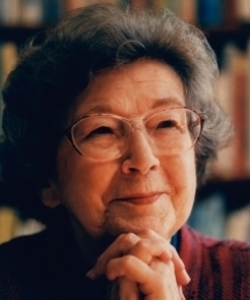
One of my favorite authors recently celebrated her 94th birthday. This is such happy news! I’ve loved Beverly Cleary’s Henry Huggins and Ramona series since I read them as a child, but even more so since I rediscovered them as a mom reading them to my own kids. They’re so pure, clean, and FUNNY.

School Library Journal posted a nice interview with Mrs. Cleary on her birthday,which was April 11. You can read the whole story here.

When asked, “What’s your legacy to children’s literature?”, Cleary answered:

I’ve done what I started to do—to write books that children would want to read, books that would let them enjoy reading. I want them to discover that reading is more than something they have to do in school. Ramona and the others are just the sort of kids who lived in my neighborhood in Portland, OR. Everything in the Ramona and Henry books could have happened in Portland and probably did.

She also talks a little about the new movie, “Ramona and Beezus,” that’s due out in July. We saw the previews for this movie when we went to see “Diary of a Wimpy Kid” (which is not nearly as funny as the books, by the way. Too much crude humor.) I think I might have squealed in the dark theater, “RAMONA’S GOING TO BE IN A MOVIE!!” I think I might have embarrassed my kids and spilled a little popcorn. But it was exciting.

The preview for Ramona was actually more exciting than the whole Wimpy Kid movie. It will star Selena Gomez as Beezus. I like Selena Gomez because I can finally tell her apart from Demi Lovato, and my daughters think I’m cool when I can roll their names off my tongue. Try saying Selena Gomez and Demi Lovato fast three times and you’ll see what it’s like to be the mother of tween girls today.

But back to Beverly!

I’m crazy about Beverly Cleary! Ask anyone! I have her beloved memoir, On My Own Two Feet, on my shelf of hallowed books, alongside my Grandfather’s 1956 edition of Kipling short stories, Alcott’s Little Women, The Bronte sisters’ Wuthering Heights and Jane Eyre, and Allen Say’s The Ink-Keeper’s Apprentice. These are the books that give me courage to write.

If you have never read Cleary’s My Own Two Feet, you absolutely must, if you love children’s books. Along with that, you’ll have to get a copy of A Girl From Yamhill as well. Both chronicle her growing up years and how all of her personal life experiences fed into her becoming one of the world’s most beloved children’s writers, whose books are ALL still in print after 60 years. Yes, I love this woman’s work.

When we visited Portland last fall, I almost couldn’t wait a second before taking my kids to the Portland city library. There was a stop on the subway (the “MAX”) for Yamhill district. I remember holding my map with shaking hands, as we approached the streets where young Beverly might have walked to check out books from the library. “This is it!” I told them. “We’re getting closer to Beverly Cleary’s library! The place where she checked out books when she was your age!!”

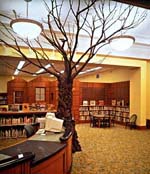
My kids wanted to go shopping at the mall and buy plastic trinkets, and to the zoo to see monkeys, but I had to take them to see Beverly’s library, which is also Allen Say’s library to me, since he lives somewhere in Portland. When we got inside, we discovered an actual room with the words, “Beverly Cleary Children’s Library” posted over the door. It was a beauiful place, with a giant tree towering over stacks and stacks of glorious children’s books. I think I might have shed a tear or two.

In My Own Two Feet, Beverly describes the point in her life when she was finally ready to start writing children’s books. It was a dream she’d carried around inside for years, but she was too busy being a student, a librarian, and then a wife to that wonderful Clarence Cleary. Finally, it was time. They were settled in a cute little house in southern California. But she struggled with writer’s block. After visiting her parents in Portland, she shares:

I told myself that if I was ever going to write a children’s book, now was the time to do it. But when I sat down at my typewriter and stared at the paper I had rolled into it, the typewriter seemed hostile, and the paper remained blank. The longer I stared, the blanker it seemed. After years of aspiring, I found I had nothing to say. Maybe it had all been a foolish dream.

Her husband kept encouraging her. While he went to work, she stayed home to try and write. They went through a difficult miscarriage, and Beverly got depressed for a while. So they moved to a different house, and this time they discovered a ream of typing paper in the linen closet, left by the former owner.

Here’s how she describes what happened next:

I remarked to Clarence. “I guess I’ll have to write a book.” My ambition, refusing to die, was beginning to bloom again.
“Why don’t you?” asked Clarence.
“We never have any sharp pencils” was my flippant answer.
The next day he brought home a pencil sharpener.

Isn’t that cute? Oh, I just love Clarence Cleary for buying Beverly a pencil sharpener and for encouraging her to stick with her dreams. She wrote some stories about a boy named Henry Huggins and his dog, Ribsy (though she originally named him “Spareribs”). She gave him a friend named Beezus and, on a whim, decided to give Beezus a sister. She named her Ramona after hearing a neighbor call out to another whose name was Ramona.

Ramona Quimby.

Cleary sent her stories to New York, and Elisabeth Hamilton of Morrow helped her turn them into a novel. Sixty years later, we’re still reading it, as well as all the ones that came after.

I adore Beverly Cleary, and am thrilled God has given her such a long, happy life. I wish her many more happy years to come. She’s an inspiration to all of us who stare at the blank page and wonder if we have something worthwhile to say.


April 15, 2010


Our family spent spring break visiting Asheville, North Carolina, and it turned out to be somewhat of a literary tour for me. As always, I’m drawn to anything related to books, and so I wanted to share with you my fascination with George Washington Vanderbilt’s astonishing library in his former personal home, Biltmore Estates.

The library contains over 10,000 books, although we learned that Vanderbilt’s original collection contained over 23,000 volumes. He was an avid reader and book collector, and our tour guide said Vanderbilt was once known as “the best read man in America.” Wouldn’t you have loved being one of his guests? Biltmore is known as the largest home in America, with over 250 rooms, including 43 bathrooms. (My children were particularly interested in that detail because we all have to share in our house. No fair.)


I was completely in awe, and my oldest daughter and I had to tour the house two days in a row to make sure we didn’t miss anything. If you have a chance to visit, I highly recommend that you spend the extra $10 to listen to the audio tour. It’s worth every penny if you love stories, and Biltmore is a home full of stories! We especially loved hearing tales about the lavish banquets and house parties. The house originally opened in 1895 for a Christmas Eve party.

Behind the library’s chimney, on the second floor, is a secret door and passageway which Vanderbilt designed for the use of his guests. This allowed them to slip downstairs, perhaps in their nightcaps, and select a bedtime book to read without having to descend the grand spiral staircase in the center of the home. How thoughtful!

Many of Vanderbilt’s guests were writers, including Henry James and Edith Wharton. On the ceiling is a painting by Venetian artist Pellegrini, entitled, “The Chariot of Aurora.” I really could have spent a week in that one room alone, though of course visitors aren’t allowed to touch any of the books. Still, what a place to dream.

Our second literary stop came as a bit of a surprise because I got so caught up in the glory of Biltmore and the Blue Ridge mountains, I didn’t do enough research before the trip.

While there, we discovered that Asheville is the homeplace of author Thomas Wolfe, whose famous novels include Look Homeward Angel, Of Time and the River, The Web and the Rock, and You Can’t Go Home Again. I haven’t read any of these books, but I’ve now got Look Homeward Angel on reserve at the library because I’m so curious as to what caused such a stir in Asheville when it was first published in 1929. It was autobiographical, based on his life in a boarding house called “Old Kentucky Home,” where he lived with his mom and their boarders (pictured below).


We visited the Thomas Wolfe Memorial, which showed a wonderful short movie about his life, as well as exhibits that included Wolfe’s desk and typewriter from his apartment in New York. I was struck by how uncomfortable his chair looked, imagining him sitting there for hours a day, composing his novels and short stories. His editor, Max Perkins at Scribner, also worked with Hemingway and F. Scott Fitzgerald.

We were sad to learn that Wolfe died 18 days short of his 38th birthday — so he got all his life’s work done by age 37. Amazing. I found it interesting to note that Thomas Wolfe was born in 1900, the same year Cornelia Vanderbilt was born at Biltmore, only daughter of George and Edith Vanderbilt. (She had quite a big house to ramble around in.)

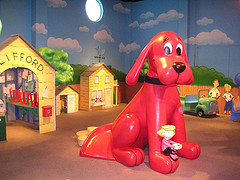
Having fun yet? OK, our last stop on this brief literary tour of Asheville is only a temporary one. We visited the CLIFFORD THE BIG RED DOG exhibit at the Health Adventure Museum at Pack Place. If you have kids, you must visit this museum, especially on a rainy day (like we did). We spent about four hours in that place, all thoroughly entertained. My older kids and husband spent the entire time upstairs in the Mindbender Mansion doing all sorts of brainy exercises, while my 5-year-old daughter and I hung out with Clifford.

What fascinated me most about Clifford is that I never thought much about Clifford as a character in literature. Yet there was a small exhibit about the book’s author, Norman Bridwell, and I’ll never look at those books the same again. His first Clifford book was published in 1962, and there are now over 160 titles in the series, with over 100 million copies in print. I think I’d consider him a successful author!

My kids, at various times, have all loved the Clifford books, and his big red dogness has helped me many times keep my eyelids propped open during late night story reading. We enjoyed watching a little movie about Norman Bridwell, who is an older man now, talking about how his drawings came to life. The setting for the Clifford books is the island of Birdwell, based on the author’s home at Martha’s Vineyard. PBS created the television series based on the books in 2000. Any parent of a preschooler will be able to recognize the sound of Clifford’s theme song coming on TV. (That’s when we all jump in the shower, right?)

I entered the world of Clifford and spent a happy time playing with my daughter, who will one day tell me she’s too old for Clifford books. I know this because it’s already happened with my four older kids.

Traveling with five children is an experience itself. My husband and I like to use the term “educational field trip” because the vacation really begins once the trip is over. But it was worth it.

I hope you enjoyed my little tour. I think I’m out of breath now.


March 23, 2010


Since I started blogging in 2005, I’ve been privileged to interview some really great people. Most of these interviews were conducted while I simultaneously typed and juggled a baby on my knee. I’ve been able to meet some of these writers in person at conferences, which is always fun.

I’ve updated the links here, so if you’re an author with a website or blog that links to one of these interviews, please update your link with my new web address. And drop me an email if you have a minute!

Claudine Aievoli, April 2007
Tracey Bateman, February 2007
Trish Berg, April 2007
Kristin Billerbeck, October 2006
Allison Bottke, August 2008 interview for Christian Women Online ezine
Barbara Cameron, November 2008 interview for Christian Women Online ezine
Colleen Coble, April 2006
Gina Conroy, May 2007
CJ Darlington, March 2010
Mary DeMuth, February 2006 (1), (2), September 2006
Jenn Doucette, February 2007
Dena Dyer, October 2006
Alyice Edrich, February 2006 (1), (2)
Suzie Eller, May 2006, October 2006
C. Hope Flinchbaugh, January 2007
Tricia Goyer, March 2007
Sheila Wray Gregoire, April 2007
Liz Curtis Higgs, January 2007 cover interview for Christian Women Online ezine
Ellie Kay, March 2007, interview for Christian Women Online ezine
Keri Wyatt Kent, April 2006
Christine Lynxwiler, April 2007
Dandi Daley Mackall, March 2007
Kathryn Mahoney, March 2006 (1), (2)
Randy Mortenson, November 2006
Kathryn Porter, January 2007
Deborah Raney, September 2006
Christy Scannell, April 2007
Donna Shepherd, May 2006 (1), (2)
Vonda Skelton, April 2006, March 2008
Susan Thacker, March 2006(1), (2)

By: Heather Ivester in: Books,Interviews | Permalink | Comments & Trackbacks (0)